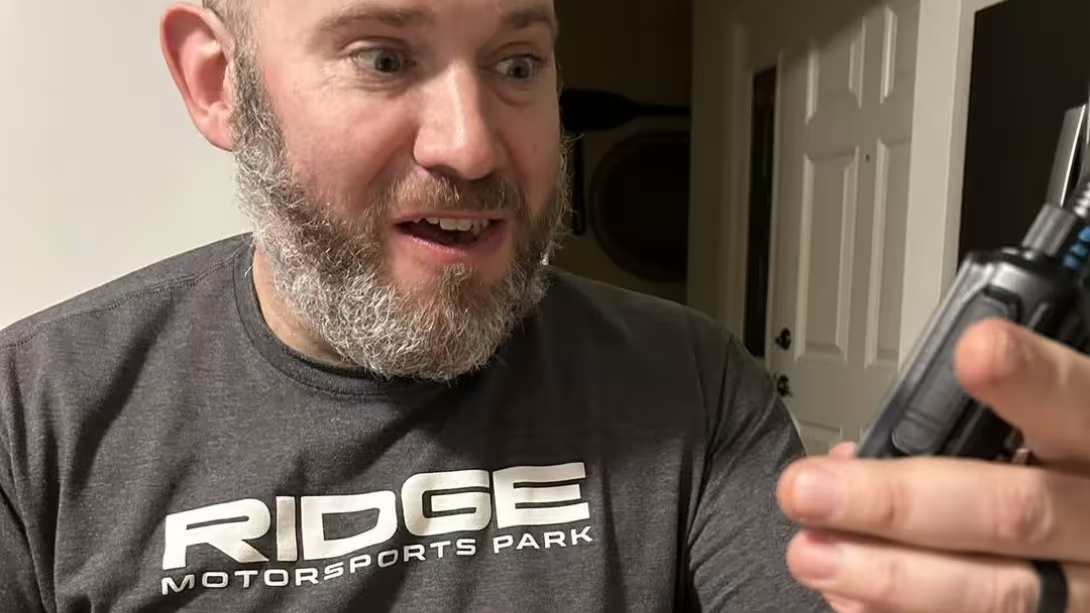
Interested in two-way radios but have no idea where to start? Good news! You don't need hundreds of dollars, a bunch of technical knowledge, or even an amateur radio license to start exploring the world of radio.
In fact, for less than the cost of a decent dinner, you can get your hands on a surprisingly capable radio, start listening to conversations happening around you, and figure out whether amateur radio is something you'd like to pursue.
Here at Real Radio Reviews, we believe the best way to get interested in radio is to actually use a radio! So forget spending weeks researching complicated equipment. Here's how we'd recommend getting started.
Step 1: Buy Your First Radio — The Baofeng UV-5R Mini
We're going to make this recommendation really simple.
Buy set of Baofeng UV-5R Minis for cheap.
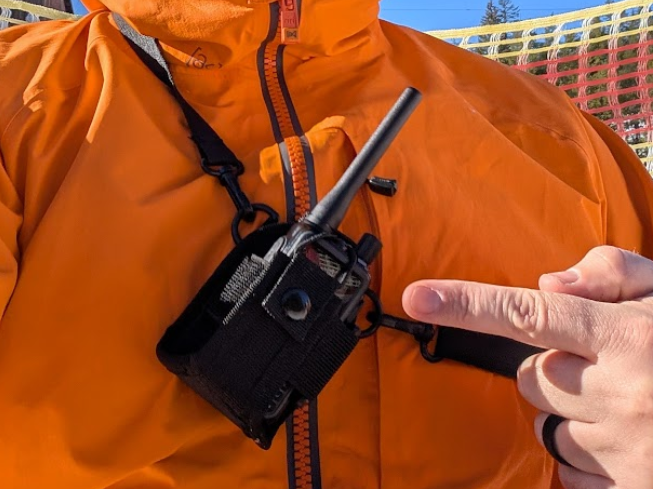
Bbuy the two pack of radios. These little radios are incredibly affordable, surprisingly capable, and compact. The UI is very novice friendly, and while you may grow past this radio you will always find yourself reaching for them. From hikes to backing up trailers to your wife wondering where you are in Home Depot, they are infinitely useful!
Why do we like it so much?
- Inexpensive: Often available for around $20 each, sometimes less when buying a pair.
- Tiny: Small enough to throw in a pocket, backpack, or glove box.
- Easy to use: One of Baofeng's better user interfaces, without the endless menu diving some radios require.
- USB-C charging: No proprietary charging cables or cradles.
- GMRS &VHF & UHF: Listen to local amateur radio activity on both popular bands.
- Programmable: Save local repeaters and frequencies so you aren't constantly entering numbers.
- Useful long-term: Even if you eventually buy a $500 radio, the Minis remain handy little companions.
We took these radios skiing on Mt. Hood throughout the 2025/2026 winter and have used them for all sorts of everyday activities. They're tough, they're capable and they've become some of the most frequently used radios in our collection.
And at their price point? It's pretty hard to go wrong.
Read our full Baofeng UV-5R Mini review, including testing, accessories, and purchasing links.
One important distinction: the Baofeng UV-5R Mini is an amateur-style radio, not an FCC-certified GMRS radio. We'll explain what that means for transmitting a little further down.
Step 2: Get Your GMRS License — No Test Required!
One of the hurdles some folks put in front of operating on the airwaves is that some segments of amateur radio take passing onerous tests to get certified and active. Welp, we're here to tell you that you can get going without having to cross any huge hurdles!
Where you should begin is buying a GMRS (General Mobile Radio Service) license.
GMRS is a separate radio service designed primarily for practical two-way communication. It's a fantastic introduction to radio because you can get licensed without studying for an exam, there's also lots of activity in the segment around the country, often overlapping with the amateur radio experience.
Here's the jist of a GMRS license:
- $35 for a license.
- 10 years before you need to renew it.
- No test or technical knowledge required.
- Immediate family coverage: Your license also covers eligible family members, including your spouse and children.
- Repeater access: GMRS supports repeaters that can extend your communication range significantly.
It's pretty friggen easy! A GMRS license allows you and covered family members to communicate on GMRs frequencies. Friends outside your covered family will technically need their own licenses... but that is an often overlooked area most folks don't concern themselves with and we've never heard of enforcement. Doesn't change the laws on the matter, but worth knowing in general.
To get your GMRS license you apply directly through the FCC. Their website is old, the process is a bit annoying, but it's all very feasible we promise!
Get your GMRS license through the FCC.
Once your license is granted, you'll receive a callsign to use when operating on GMRS.
Wait... Can I Use the UV-5R Mini on GMRS?
Ahhh, you've discovered one of the more controversial topics in the radio community! The UV-5R Mini is technically capable of transmitting on GMRS frequencies, and tens of thousands of people use it and radios just like it for GMRS communications.
However, technically the FCC requires GMRS transmitters to have the appropriate equipment certification. The UV-5R Mini doesn't have that certification. Now there's plenty of debate among radio enthusiasts about whether these restrictions make sense, especially since radios like the UV-5R Mini are near ubiquitous on GMRS frequencies. e've put together a separate article explaining the regulations, the controversy, and the realities of how people use these radios.
GMRS on Ham Radios: The Legality, the Controversy, and What You Should Know
The short version though is: It's not legal, so is jaywalking and speeding... but if you do something dumb it's on you, so don't be a dummy.
Step 3: Utilize AI & Program Your Radio
Programming your first radio might seem intimidating, but AI makes learning about radios easier than ever!
We highly recommend using ChatGPT or your favorite AI assistant throughout this entire process. Think of it as your personal radio mentor. It can explain unfamiliar terminology, walk you through programming, and help troubleshoot problems.
Try starting with this prompt:
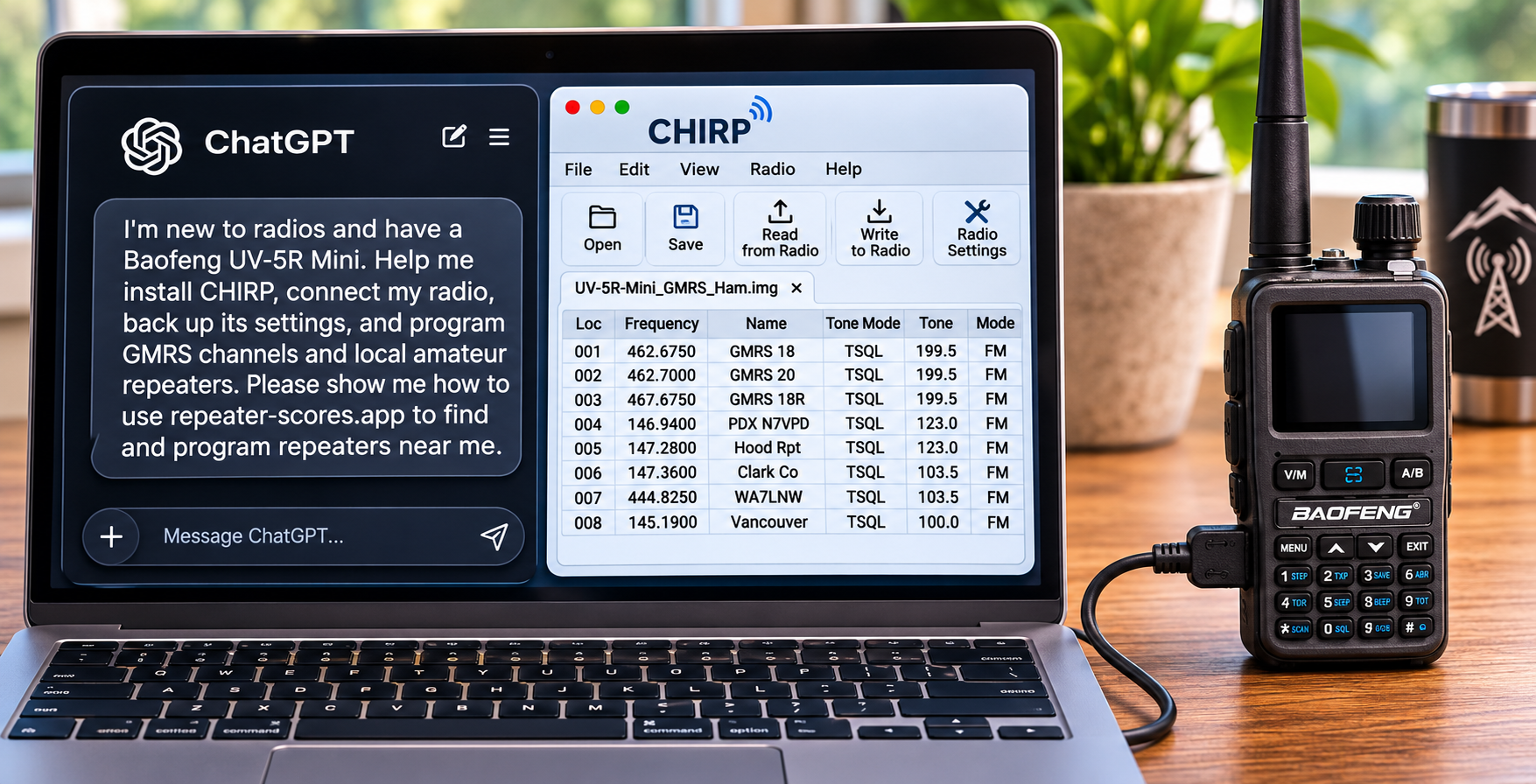
I'm new to radios and have a Baofeng UV-5R Mini. Help me install CHIRP, connect my radio, back up its settings, and program GMRS channels and local amateur repeaters. Please show me how to use repeater-scores.app to find and program repeaters near me.
Guide me one step at a time, ask questions when needed, and help troubleshoot problems. Keep explanations simple and concise. I already understand the GMRS legality considerations, so skip regulatory discussions and focus on getting my radio programmed.
Programming with CHIRP
Rather than entering frequencies manually in the UI, we recommend CHIRP which is free software that makes programming your radio much easier.
You'll need a compatible USB programming cable (covered in our UV-5R Mini review).
- Install CHIRP and connect your radio using the programming cable.
- Select
Radio → Download From Radioand choose the correct radio model and connection. - Save a backup of your original configuration!
- Add frequencies, channel names, and repeater settings.
- Select
Radio → Upload To Radioto transfer everything back.
For channels you're only listening to, set Duplex to off in CHIRP to prevent accidental transmissions.
Stuck on something? Ask AI! You can even share screenshots of CHIRP and ask it to explain specific settings.
Next: Let's Find Some Repeaters!
Wait what's a repeater? Repeaters are essentially radios that have a very high vantage point, really good antennas, and lots of output power. They listen for a transmission, and repeater it from a far higher elevation with far greater power. That means if your little 5 watt radio can reach the repeater on a nearby mountain top (and it likely can), said repeater will retransmit what you said... but at 20x the power and without the same obstructions. That's how little radios can get 60+ miles of reach.
Now as for finding repeaters... we're about to introduce you to Repeater-Scores.app, which can generate CHIRP-compatible lists of amateur repeaters worth monitoring. Specifically, go to their Nearby Repeater search tool, provide or enter your location, and you'll get a list of all the nearby repeaters and their scores. We highly suggest taking note of the highest scoring repeaters near you and monitoring those for activity. With CHIRP, AI, and Repeater Scores, you'll be exploring local radio activity in no time!
Step 4: Start Using GMRS for Actual Communication
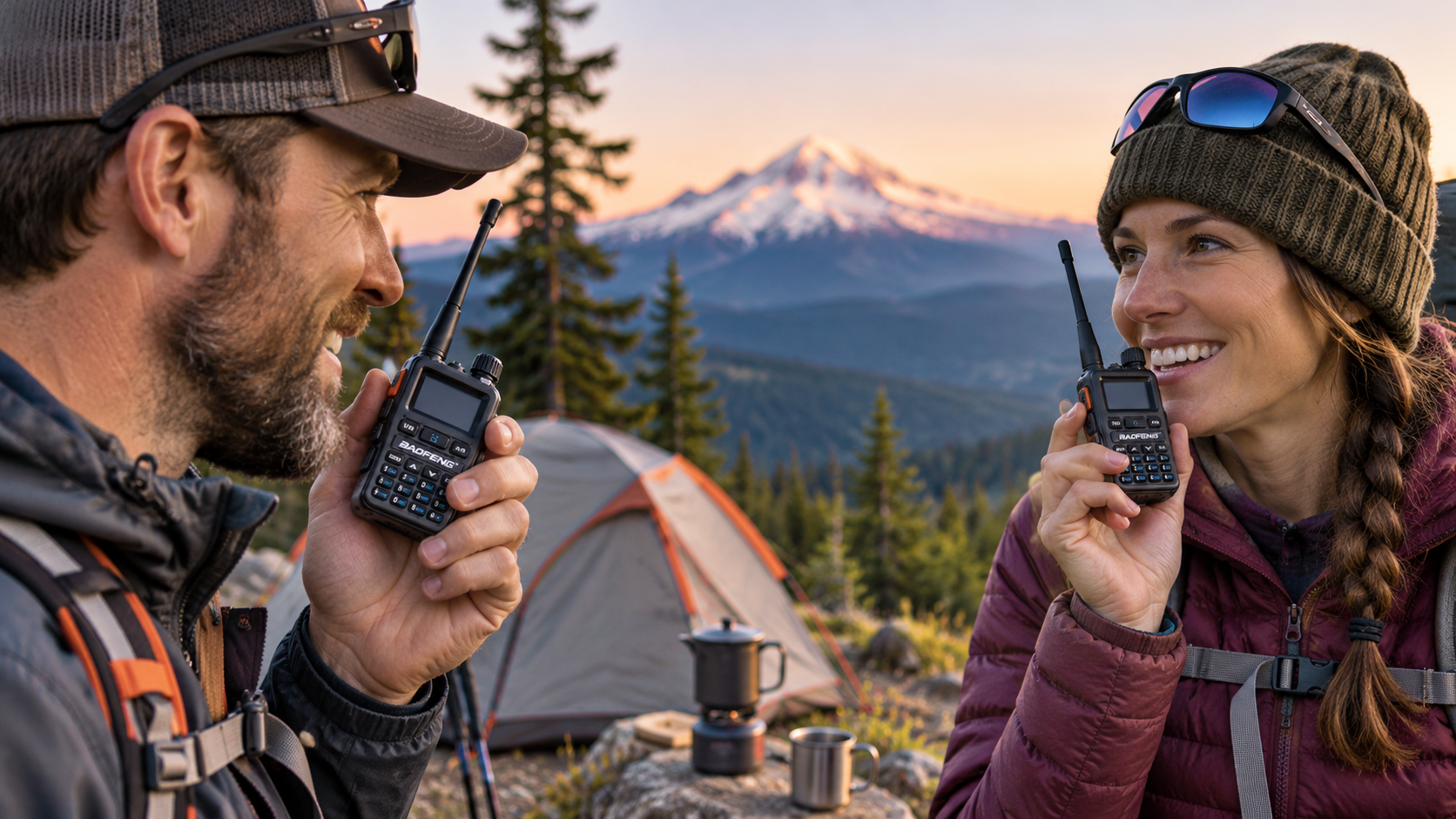
Now for the fun part. You've got your license, a programmed radio, and now you can start talking! Grab a friend or family member, and find something practical to use your radios for.
Some of our favorite examples include:
- Home depot, farmers markets, fairgrounds, etc: Radios are a great way to stay in touch out and about and have some fun with conversation while doing so.
- Hiking and camping: Stay in touch when cell service is unavailable or where you don't want to be on your phone.
- Road trips: Communicate between vehicles without constantly making phone calls.
- Around the house or property: Coordinate projects or communicate between the house, garage, and shop.
- Outdoor activities: Mountain biking, kayaking, and other adventures where communication is useful.
- Skiing and snowboarding: Keep track of your group when everyone heads down different runs.
For basic radio-to-radio communication, you don't even need a repeater. This is called simplex, meaning your radios communicate directly with one another.
Just select the same appropriate GMRS channel on both radios and start communicating.
You'll quickly discover one of the most important lessons in radio: range depends heavily on terrain, obstacles, antenna performance, and your location. A five-watt handheld may struggle to communicate a mile through dense buildings or terrain, yet work over surprisingly long distances when both users have good elevation and a clear signal path.
Experiment! That's half the fun.
What About GMRS Repeaters?
We discussed repeaters earlier, and linked you to a tool for finding amateur radio repeaters. GMRS repeaters do exist however, and you can find local GMRS repeaters using the RepeaterBook GMRS directory. Some repeaters are open to everyone with a GMRS license, while others are private or require permission. Check the listings and see about finding a repeater near you.
Step 5: Discover Amateur Radio — No License Needed to Listen!
Here's where things start getting interesting.
While GMRS is fantastic for practical communications, amateur radio opens up a much larger world of radio activity.
GMRS has fairly limited frequencies, and especially limited repeater coverage. Amateur radio however has far more frequency range and space, and operators use repeaters for everything from casual conversations to technical discussions, organized activities, emergency communications, and regularly scheduled gatherings.
And the best part?
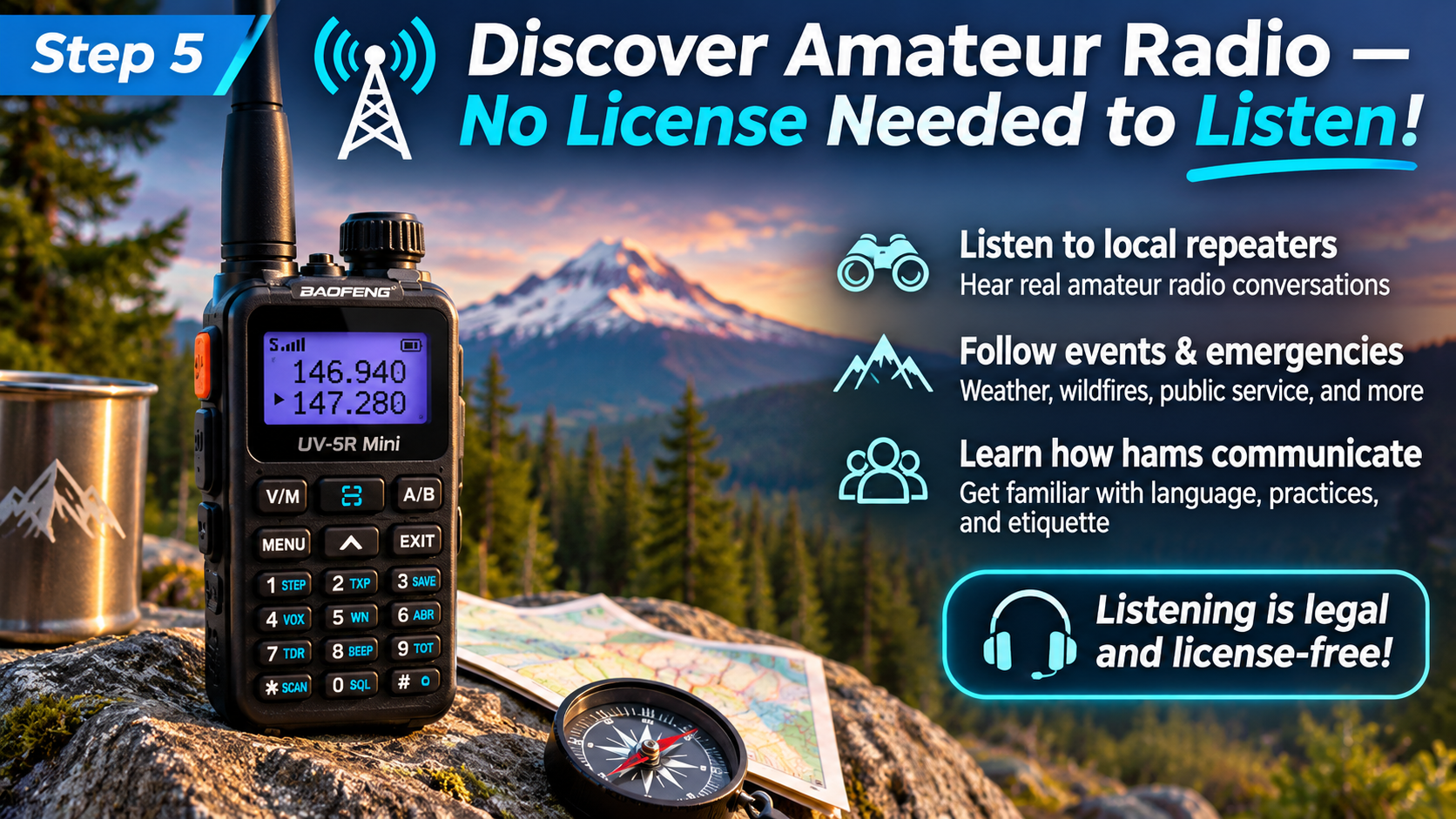
You don't need an amateur radio license just to listen and see what is going on!
Your UV-5R Mini can receive radio conversations on the popular "2-meter and 70-centimeter bands" aka VHF and UHF (very high and ultra high frequency range).
You can listen to local operators talking about their projects, discussing antennas, helping newcomers, or simply chatting about their day.
But there's a catch.
Finding Active Repeaters Can Be Frustrating!
If you're new to radio, you might search online for local repeaters and discover dozens of them.
Great! You program a bunch into your radio, press Scan, and...
Nothing.
Silence.
You wait another 20 minutes.
Still nothing.
It's easy to assume your radio isn't working, or that nobody uses amateur radio anymore.
But plenty of repeaters sit quiet for long stretches. It's going to sound crazy, but most folks have jobs and lives outside of radio! Some are only used for specific events, some have limited coverage, and others are simply less popular.
The trick is finding repeaters that are more likely to have activity.
Fortunately, we've got a tool specifically designed to help with that!
Step 6: Find Active Repeaters with Repeater-Scores.app
Repeater-Scores.app was built to solve a problem we kept running into ourselves: repeater directories are great at telling you which repeaters exist, but not necessarily which ones are likely utilized.
Repeater Scores uses data from RepeaterBook (the main online directory of repeaters) and assigns repeaters a score based on indicators that suggest they may see more activity.
Some of those indicators include:
- Regularly scheduled radio nets. (AKA: Regularly scheduled get togethers)
- Repeaters connected to larger linked systems. (AKA: Connected to multiple repeaters around the county/state/country/world)
- Wide-area or regional coverage. (AKA: Ontop of a mountain)
- Connections through services such as AllStar and EchoLink. (AKA: Can be remotely accessed from an internet connection like your phone)
- Emergency communication and public-service affiliations. (AKA: More likely monitored and utilized)
The idea is simple: higher-scoring repeaters are generally busier places to start listening.
A score isn't a live measurement of traffic, and it isn't a grade out of ten. It's our estimate of how useful or active a repeater might be based on available information.
How to Get Started
- Visit Repeater-Scores.app.
- Select your state and any neighboring states you want to explore.
- Set a minimum repeater score. We recommend starting at 2, which helps eliminate many lower-information or less-promising listings.
- Choose CHIRP as your radio export format.
- Generate and download your repeater list.
- Use CHIRP to inspect the list and select repeaters near your location to program into your UV-5R Mini.
CHIRP is free radio-programming software that allows you to manage your radio's saved channels from your computer. You'll generally need a compatible programming cable.
The UV-5R Mini can store plenty of local repeaters, and once they're programmed, you can scan through them without constantly typing frequencies.
For amateur repeaters you're only listening to, configure the memories for receive-only operation so you don't accidentally transmit without an amateur license.
A couple of important details: Repeater Scores currently focuses on amateur VHF/UHF repeaters, not GMRS. It generates regional lists rather than providing a live GPS-based nearby search on the UV-5R Mini. You'll still want to choose repeaters within practical receiving range of your location.
Repeaters on mountaintops can cover surprisingly large areas, so don't dismiss one just because it's farther away than a repeater down the street!
Step 7: Find a Radio Net — Your Best Chance to Hear Some Action!
This might be our single favorite recommendation for beginners.
Find a local amateur radio net and listen in.
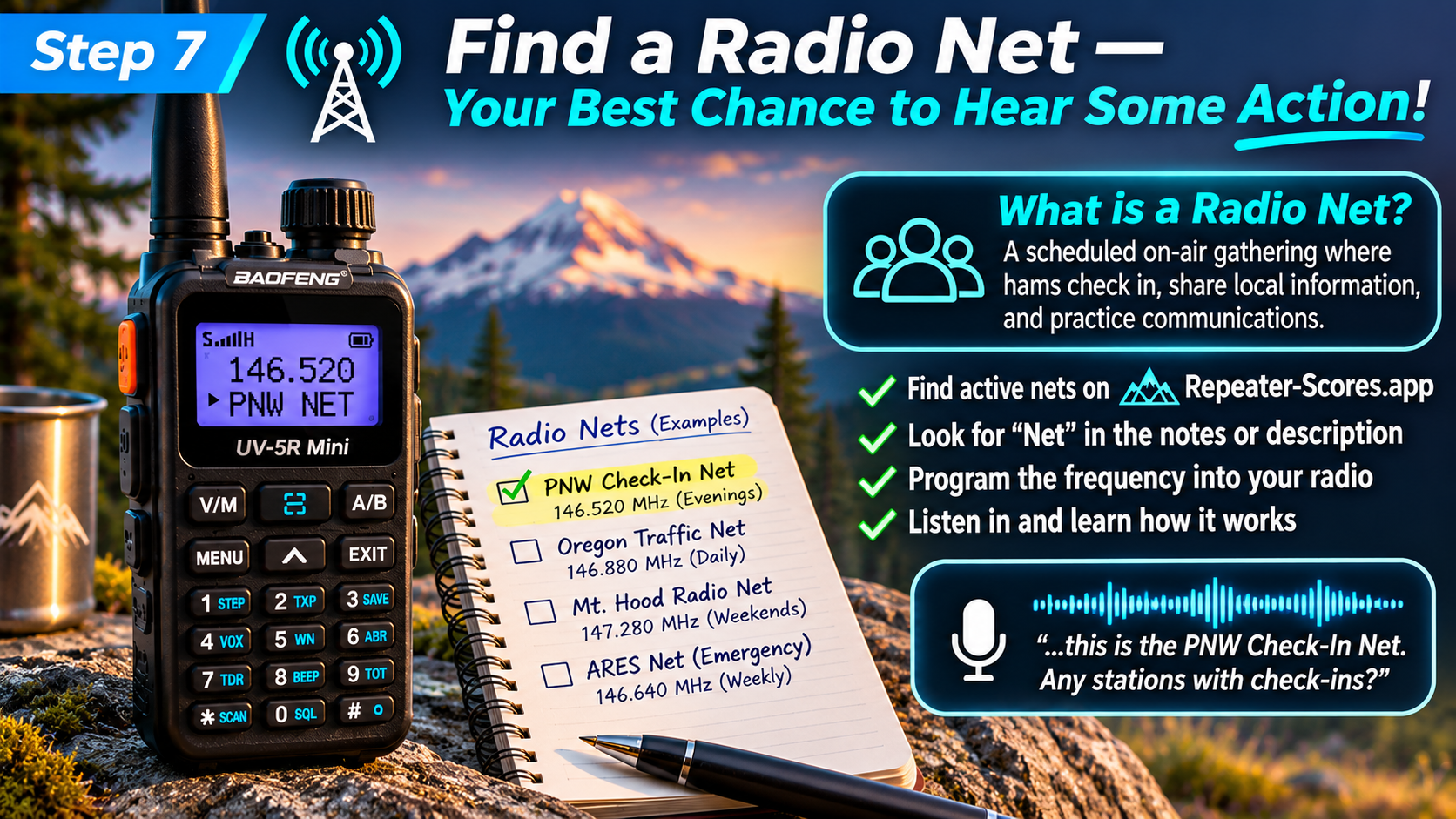
A net is a scheduled gathering of amateur radio operators on a particular frequency or repeater.
Instead of hoping somebody randomly starts talking, you can tune in at a scheduled time when operators are expected to be on the air.
Nets come in all kinds of varieties. Some are casual weekly gatherings where operators check in and say hello. Others focus on technical topics, weather, public-service communications, or particular hobbies.
Many are welcoming to new operators, and listening to a net is a great way to learn how radio conversations work.
How to Find One
Start by looking at the higher-scoring repeaters from Repeater Scores.
Then click the link to those repeaters RepeaterBook listings.
Check whether they list any regular nets, including the day and time. For example, you might discover a local repeater hosts a weekly net every Monday at 7:00 PM.
Put that on your calendar, tune your UV-5R Mini to the repeater's output frequency, and listen.
Make sure you've got the correct time zone, and remember that schedules occasionally change.
A scheduled net isn't an absolute guarantee of activity, but it's one of your best opportunities to hear multiple amateur radio operators in a relatively short period.
It's also a great way to learn:
- How amateur operators identify themselves.
- What callsigns sound like in actual conversation.
- How repeater conversations are organized.
- The etiquette of joining or leaving a conversation.
- What kinds of activities your local radio community enjoys.
You might even discover a local radio club you'd like to join.
And if a net sounds interesting enough that you wish you could participate, that's a pretty good sign amateur radio might be for you!
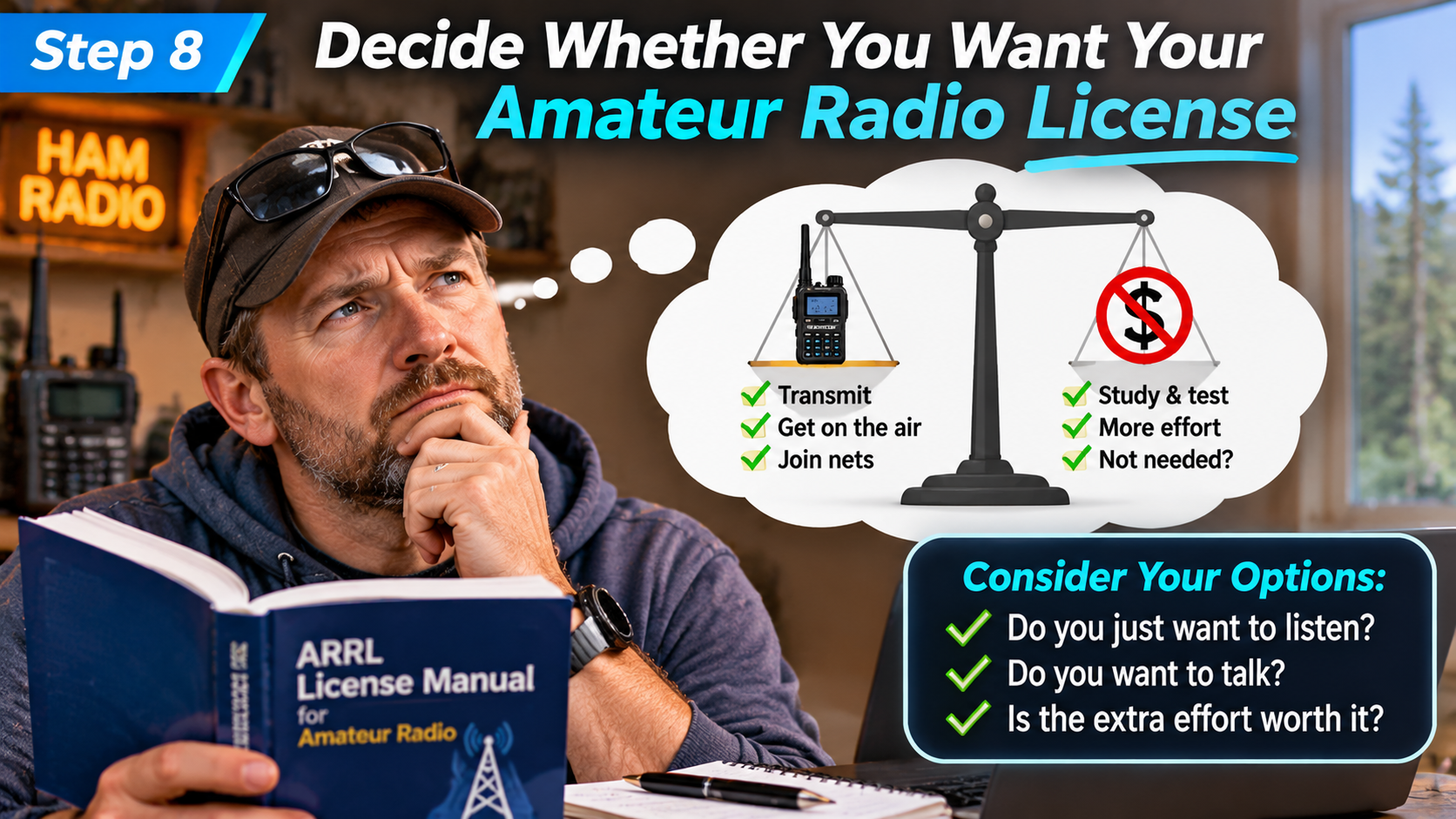
Step 8: Decide Whether You Want Your Amateur Radio License
By this point, you've hopefully done two things.
First, you've learned how useful two-way radio communication can be in everyday life.
Second, you've spent some time listening to amateur radio and discovered what local operators are up to.
Now you can make an informed decision about whether getting your amateur radio license sounds worthwhile. It's a decent bit of effort, but you now have enough familiarity to determine if it's worth it to you.
In the United States, the entry-level amateur license is called the Technician license.
Unlike GMRS, it requires passing an examination covering basic radio theory, regulations, and operating practices. But don't let that scare you away! You don't need to be an electrical engineer, and there's an enormous amount of free study material available.
We highly endorse downloading the Ham-Study app and focusing on the questions and memorizing the answers. Do not be concerned if you do not know the actual theory behind the question, the vast majority of the FCC questions have nothing to do with operating. You do not need to know the parts of a circuit board or have equations memorized. Once licensed you can and SHOULD refer back to technical documentation when doing anything anyways.
...And if amateur radio doesn't end up being your thing? That's perfectly fine too! GMRS is a useful hobby and communication service in its own right that is growing faster than amateur radio is! There's absolutely no requirement to become an amateur radio operator to enjoy using radios, but you should know before you go.
Our Recommendation: Start Small, Have Fun, and Learn as You Go
One of the biggest mistakes beginners make is believing they feel the need to understand everything about radio before starting. Folks like that go straight to the craziest level of intense testing and certification, and then feel the need to buy a $4,000 radio that can do everything and reach the international space station.... and then discover it's not for them or they have insane technical knowledge but none of the general chat familiarity that is the actual backbone of ham radio.
DO NOT BE THAT PERSON!
We've tested radios costing hundreds of dollars that have incredible features, beautiful displays, sophisticated digital modes, and all sorts of technical capabilities.
They're great radios.
But none of that matters when you're just trying to figure out whether you'll enjoy the hobby.
That's why we keep coming back to the Baofeng UV-5R Mini.
It's affordable, compact, fun to experiment with, and a surprisingly capable receiver for exploring local activity and testing the waters of the hobby.
Here's our suggested path:
- Pick up a Baofeng UV-5R Mini and start exploring what you can hear.
- Get your GMRS license and enjoy legal two-way communication with certified GMRS equipment.
- Visit Repeater-Scores.app to identify promising local amateur repeaters.
- Find a scheduled net and tune in to hear what amateur radio is all about.
- Get your amateur radio license if you find yourself wanting to join the conversation and don't bog down on knowing everything, just get the answers memorized on Ham-study.org.
That's it. No thousand-dollar shopping list. No complicated equipment requirements. No pressure to become an expert overnight. For less than the cost of a meal and drink at a restaurant you are in the game.
Get a radio, listen to what's happening around you, and see where the hobby takes you.
Welcome to the world of radio!