Specs & Ratings
Bottom Line
The Ed-Fong DBJ-1 dual band antenna nails the performance for dollar spent ratio. For $50 shipped in the continental US plus a five dollar 5 foot long piece of PVC from Lowes (Part # 23990) you're all in for $55 and have a pretty good antenna!
Pros
- Cheap!!!!
- Dead simple to assemble. Below the simplest piece of IKEA furniture.
- Solid dual band performance.
- Profits supports college students.
- Simple and Durable
- Reasonably size and compact.
Cons
- Higher SWR than similar sized Comet/Diamond antennas, but still very workable and station safe.
- UHF falls off measurably from Nat UHF for us.
- Terrible on GMRS with an SWR > 4
Who This Is For
This is definitely an antenna for the budget conscious individual. Why a person though might be budget conscious are quite numerous. Here's some examples we thought of:
- You buy this and you aren't buying another expensive radio item your significant other will get upset about.
- You're worried your stuff could get damaged, so put up something cheap and durable and if it goes out, get another two more before you've spent Diamond level money.
- You're HF focused both in interest and in budgeting, but should have something for local VHF/UHF comms, and this does the trick!
Testing Notes
We performed all testing with an ICOM ID-5100 radio operating on medium power. All measurements were taken using a Surecom SW-102. We first tested our wiring with a 50 ohm dummy load and confirmed an SWR of 1.01 or less on all frequencies we'd be testing. We then tested our DIY J-pile to captureit's SWR readings and then we tested the Ed Fong DBJ-1 antenna. . From there we did some test TX on nearby known repeaters. Also while testing the Ed Fong antenna we caught a fellow contesting on Nat UHF from an 18+ mile away state forest.
Detailed Review
So here at Real Radio Reviews, we primarily utilize radios for mobile/portable considerations. Whether it's handhelds for group coordination while skiing, backing up a trailer, coordinating whitewater groups, we find that we gravitate towards the functional and practical side of radio communication. That said, we do have a base station, but since it's more of a slow day curiosity than primary focus it's a bit of the "cobblers shoes" situation. Multiply that by the fact we like to do things ourselves... and our home base station setup is pretty modest after thought to our mobile rigs and handheld setups.
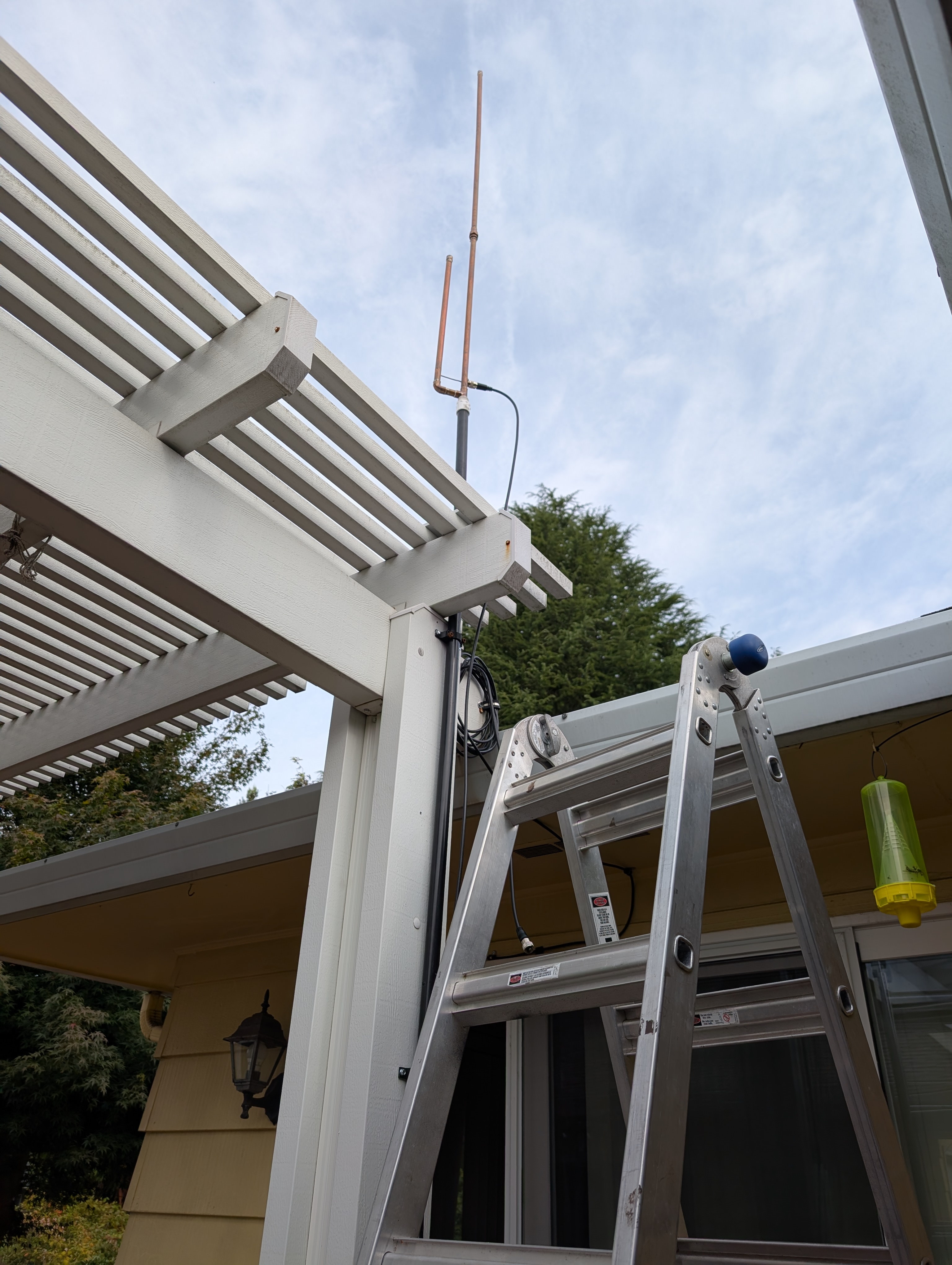
Prior to getting the Ed Fong DBJ-1 antenna, our home antenna was a simple DIY copper pipe base J-pole antenna. That J-pole antenna was also not something we even designed or made up ourselves, it was part of a bunch of gifted equipment from a friend who thought they'd get more into the hobby but didn't find themselves invested. So we took the J-pole, mounted it up on our back porch Pergola, and hey what do you know it works well enough and we can reach everything we care to reach! Not bad not bad!
The success of our DIY J-pole unfortunately came to an end after a large and unexpected summer rainstorm resulted in water intrusion throughout the antenna. Said water intrusion gave us a greater than 4 SWR on VHF frequencies, which is normally where the J-pole shined. So we took the antenna down, dried it out, re-soldered the joints more robustly than the original maker while also cleaning up the connection... and along the way said... ya know this is a lot of effort for what is a pretty meh antenna... maybe it's time we invest in a better antenna.
So how do you go from "let's invest in a better antenna" to a DIY $50 antenna that you shove inside of some PVC pipe from Lowes? Well the same way all internet rabbit holes go. You start looking, and searching, and boy are these name brand options good, but expensive... oh hey what's this one folks are talking about? $50!?!? Tons of history and articles written about it and proceeds support students?!? I'll take it!
Ordering the Antenna is a bit old school. First you go to Ed Fong's website (https://edsantennas.weebly.com/). Where you cruise the rather information light website. While Ed-Fong does make a bunch of antennas, there's only a few you'd likely consider for ham radio use. Once you select a radio you want, you shoot an email over to Ed-Fong, and he'll coordinate payment. There's a few ways to pay, and we went with PayPal. We also paid a little extra incase there were fees on his part, so we ultimately paid $55, and we figured those extra $5 could just go to the students so no big deal.
Ed Fong is California based and we're Washington state based, so the Antenna was in our mailbox inside of 3 days. We got the package, opened it up, and it's about as simple as it gets. There are two PVC end caps, one of which has a SO-259 connector and a length of various wiring attached to it that serve as the antenna. There's some basic instructions included, but the jist of it is simple.
- Go to Lowes and get 5ft of 3/4 inch 200 psi pvc pipe (Lowe's item number 23990). Note: We could only find 10 feet, so buy that and cut in half.
- Put end cap on on end.
- Insert wire and feed into pipe, finishing with final end cap with SO-250 connector put on the pipe.
- Mount as desired, using only the first 10" of the antenna.
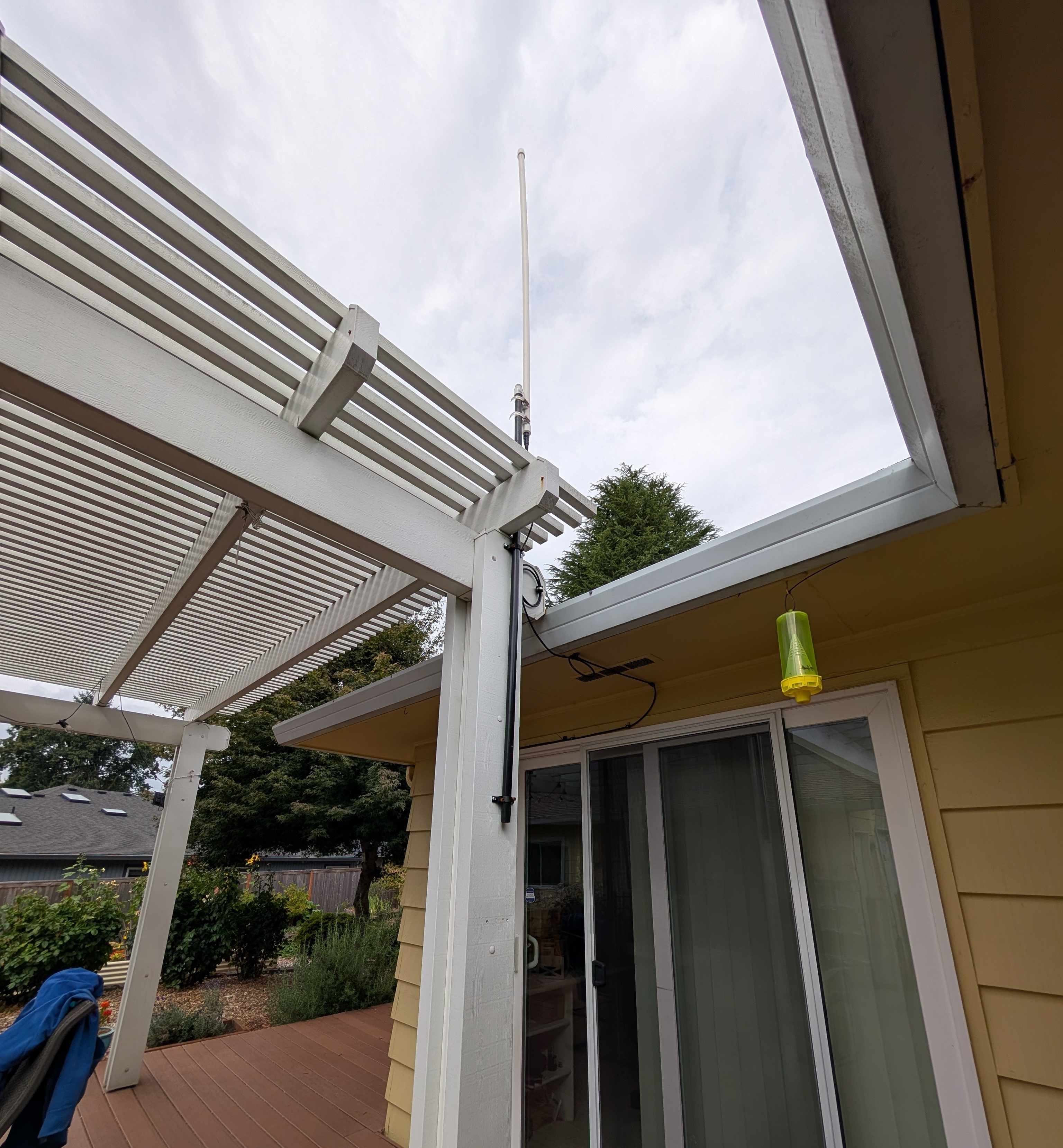
Our mounting setup was decidedly DIY and low buck build in nature. We had a 1" OD heavy duty fiberglass broomstick handle laying around that we'd originally used with the copper J-pole. We'd affixed said broomstick to our backyard porch pergola with some simple 3d printed bridge brackets we made up (OnShape design here | . For us, any excuse we can find to design something and 3d print we take because it's a fun excuse to develop our CAD skills! In the case of mounting our copper J-pole with the broom stick, it just so happened to fit right inside the end of the broomstick, which of course made it incredibly easy to toss up. That was not the case for the Ed Fong antenna however.
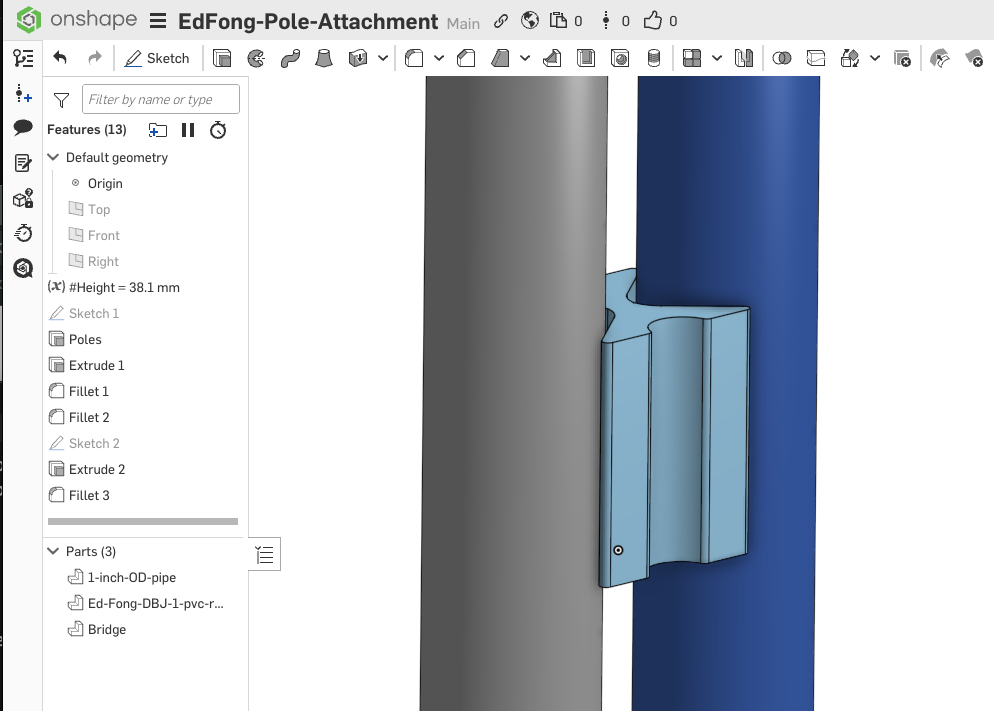
Since we didn't have the "luxury" of just pushing the antenna in the broomstick end and letting the antenna weight keep it in place, we instead designed up some simple "bridge" brackets, printed them in 45 minutes on our Bambu P1S. Seemed simple enough, and yet another excuse to improve at CAD, along with justify the ownership of several thousand dollars worth of 3D printers.
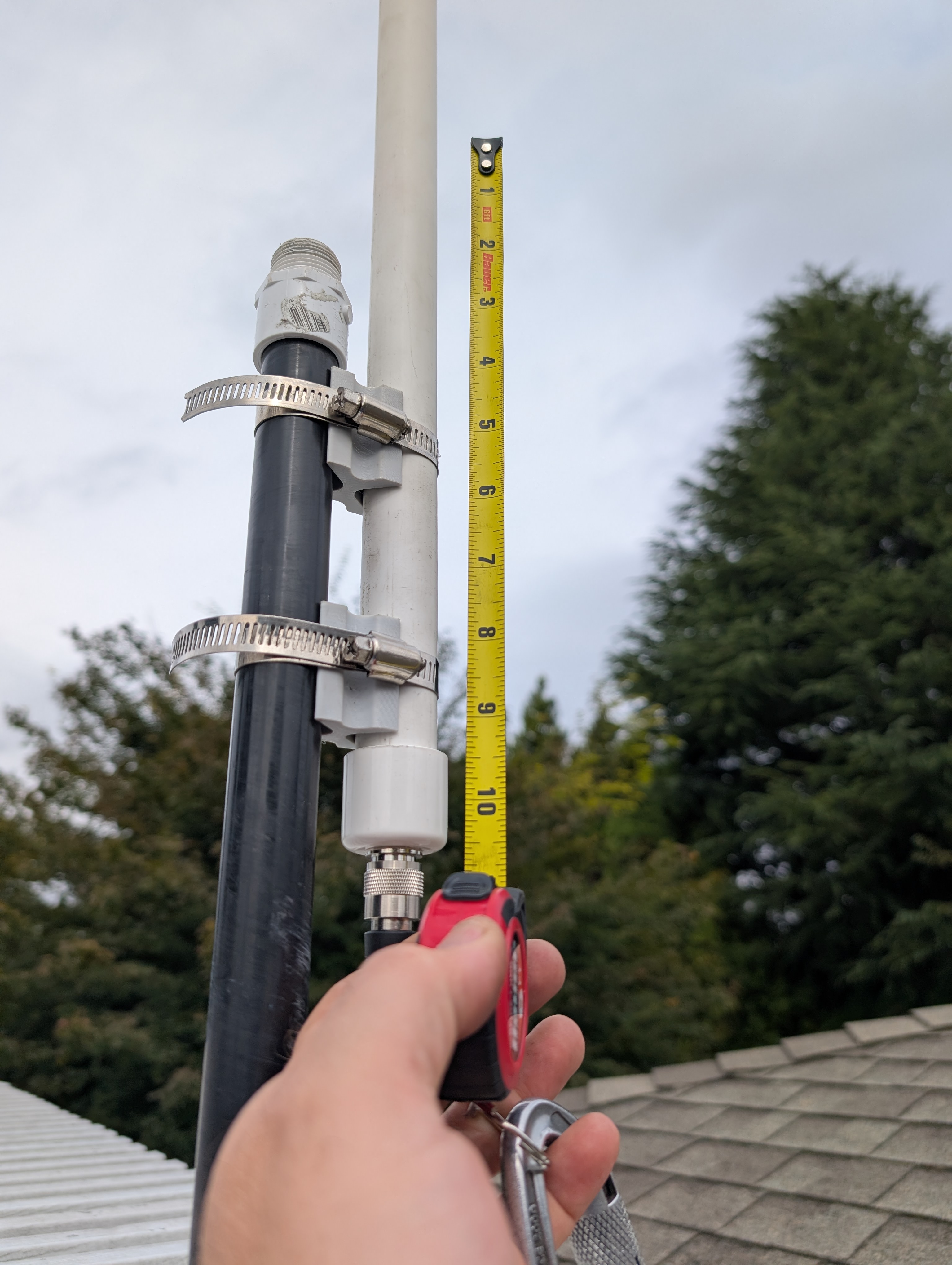
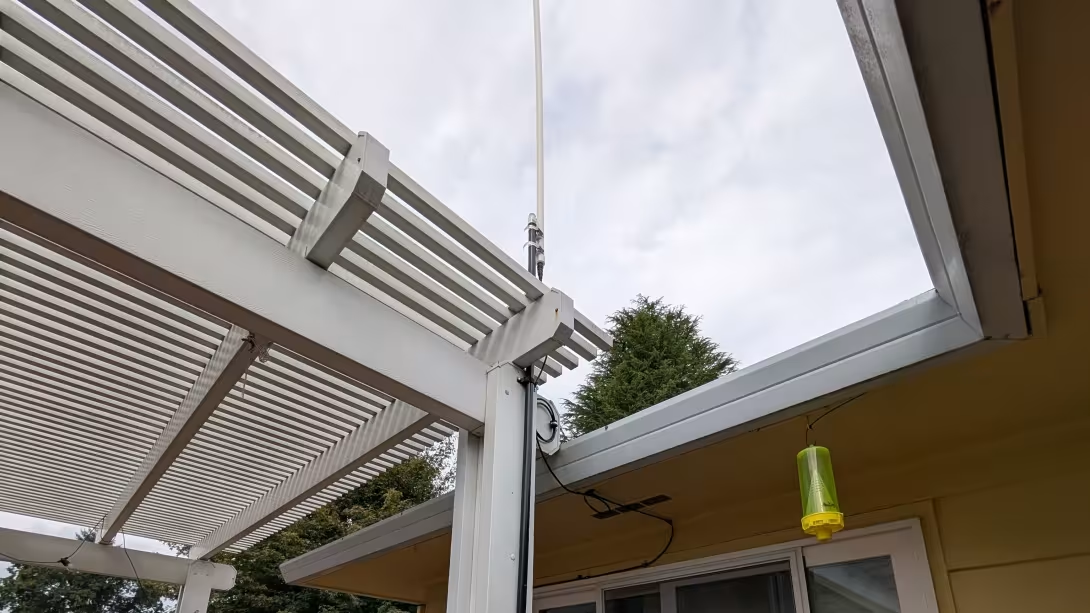
Ed Fong notes in his mounting instructions that the first 10" are feed line, and thus safe to mount to. We took the picture above to demonstrate that all of our mounting was wll under the 10" considerations. We also later went out and adjusted the mount a bit further up, now keeping the entire mounting well under 6". We also gained a few inches of extra height on our antenna, and height is might!
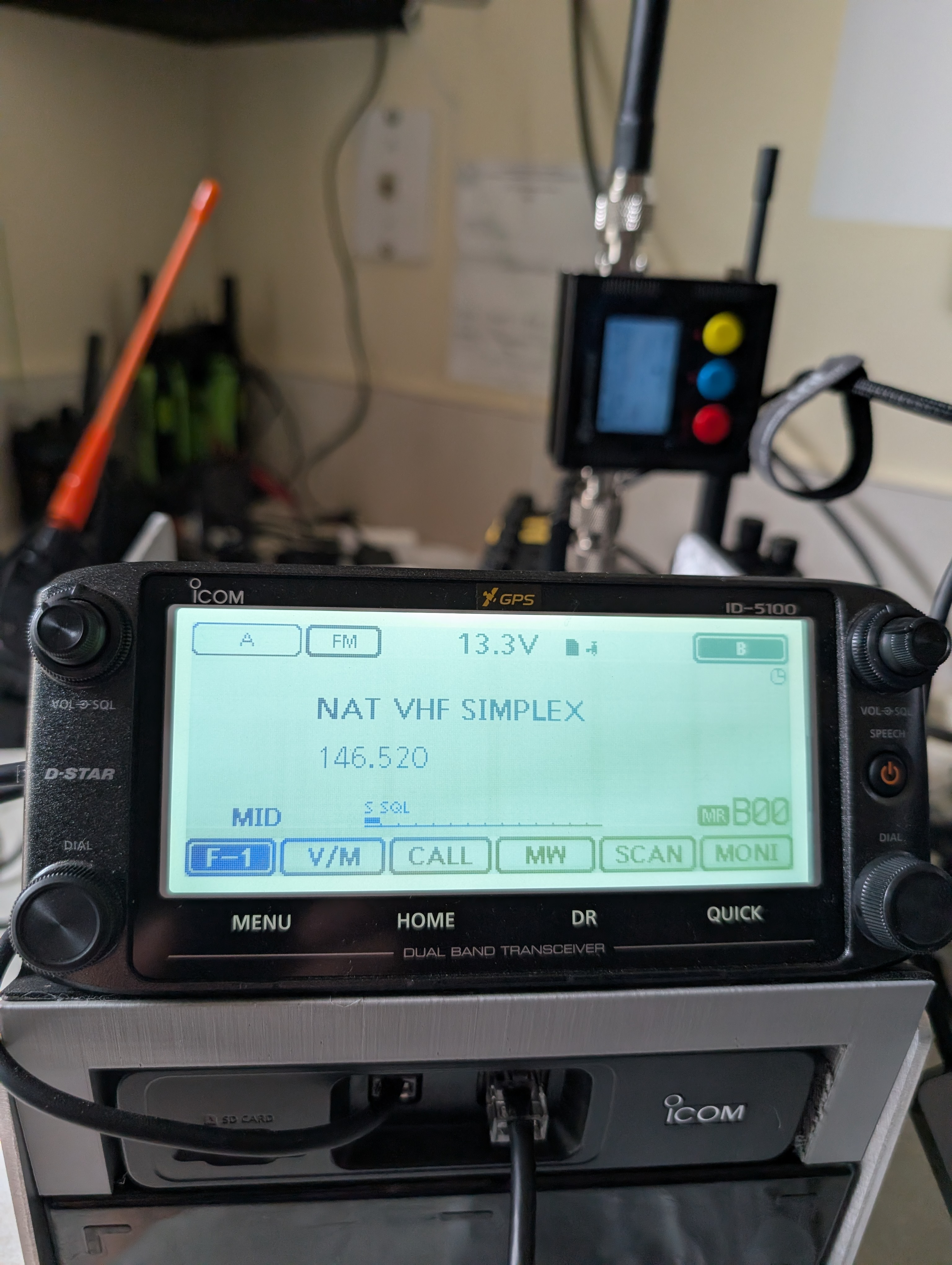
Next up we connected our ICOM-5100 directly to the antenna to take some SWR readings. We'd already earlier taken some measurements on our DIY copper J-pole antenna, and for fun we took measurements with the Ed Fong Antenna to compare. You can see the measurements in the section below, but in general we found the Ed Fong Antenna to be a solid dual band antenna, while our DIY copper J-pole was a bit more VHF focused with some modest UHF capability.
We wrapped up the install by cleaning up the previous rats nest of excess cabling we'd had laying around, and this time for good measure took to wrapping all of our exterior connection points with self fusing silicone tape.
Afterwards we kept using the antenna for the afternoon while writing this article, and made a bunch of contacts. We reached several POTA stations, a few folks calling out on repeaters, and even joined one early afternoon net. All signal reports were good. We also for fun started trying to reach some further away repeaters, such as the Barlow Trail Repeater up on Mt. Hood, which as the crow flies from us sits 48 miles away... but that's a repeater on the side of a Volcano so no exact surprises there.
Performance wise we were both impressed by the Ed-Fong DBJ-1 antenna and our DIY J-Pole antenna! The DIY J-pole antenna was clearly more VHF focused, beating out the Ed Fong DBJ-1 antenna there, though the practical difference was negligible. On UHF though the Ed Fong antenna was a far better balance, though we were surprised at how quick it fell off from center. We tested a few other UHF frequencies and found the closer we got to 446 the better the antenna did, but drifting further away the fall off was quick. Perhaps the biggest example of a fall off though was for fun we went to test on GMRS Channel 1, and boy are we glad we turned the radio all the way down to 5W we found an SWR of greater than 4! Fortunately for us, we don't ever do anything on GMRS from this radio so no love lost there, but if you want a SHTF ready antenna that will also do GMRS... this isn't it.
We'll keep updating this review as we go, but we doubt much will change. We're ultimately pretty happy with the antenna. For the price, it's hard to beat, and while you can perhaps DIY something up for a little less... if you just want something simple to chuck up to get yourself in the VHF/UHF game, the Ed Fong DBJ-1 is hard to beat!
Measured SWR
Measuring Device: Inline Surecom SW-102
Comparative results:
Frequency / Use | DIY J-pole | Ed Fong DBJ-1 |
|---|---|---|
146.520 MHz — Nat VHF | 1.24 | 1.38 |
147.840 MHz — VHF repeater TX | 1.57 | 1.83 |
446.000 MHz — Nat UHF | 2.30 | 1.29 |
448.125 MHz — UHF repeater TX | 1.86 | 1.94 |
GMRS Channel 1 | (Not tested) | 4.34 |
Stand Alone Results:
Frequency | Use | Ed Fong DBJ-1 SWR |
|---|---|---|
146.520 MHz | National VHF simplex | 1.38 |
146.800 MHz | VHF repeater | 1.40 |
147.200 MHz | VHF repeater | 1.78 |
147.840 MHz | VHF repeater TX | 1.83 |
444.225 MHz | UHF TX | 2.35 |
446.000 MHz | National UHF simplex | 1.29 |
447.865 MHz | UHF TX | 1.80 |
448.125 MHz | UHF repeater TX | 1.94 |
448.925 MHz | UHF TX | 2.22 |
462.5625 MHz | GMRS | 4.47 |
462.675 MHz | GMRS | 4.50 |
***measuring SWR with an inline device is imperfect, but has some value especially as we test every handheld radio the exact same way.
Final Verdict
The Ed Fong DBJ-1 antenna delivers as advertised! It stays well into usable SWR range across any frequency you'd want to use and does VHF and UHF admirably. While the UHF SWR around 2 range might sound high... I was getting excellent signal reports from nearby repeaters so it clearly didn't hold the radio back any.
The DBJ-1 antenna is also dirt cheap, dead simple, and near foolproof to put together (save for getting the wrong pipe, but by know you should know what to do).
You can't expect much for $50 these days, and in that regard the Ed Fong DBJ-1 antenna over delivers. There's no reason for you to not have a VHF/UHF antenna of some kind for your home base, and seldom few excuses can survive the practicality of this budget friendly and capable DIY antenna.